
ZACH CLARK
EDUCATOR | CHANGE AGENT | ADVOCATE
ZNC CONSULTING

zach's (short) story
First of all, call me Zach! I grew up right outside of Pittsburgh, PA, I'm a true Yinzer, & I love the Steelers, Pirates, & Penguins! I'm a proud Crimson Hawk as an alum of Indiana University of Pennsylvania, where I graduated from the Student Affairs in Higher Education graduate program, a proud Bearcat as an alum of Saint Vincent College, where I graduated from the History Education undergraduate programs, & a proud Cavalier as an alum of Kiski Area High School, where I graduated from the Academic-Scientific Honors track. I am committed to lifelong learning & professional development, so those degrees do not represent the terminus of my education. I have 16 years of broad experiences across various industries, including student affairs, event & conference planning, consulting, non-profit management, mental health, & bar & taproom management. I'm currently job searching, launching my consulting firm, & rediscovering everything this world has to offer & what I can do to make this world a better place!
As a professional educator, I specialize in student-centered practices & approaches in the cocurriculum:
-
developing comprehensive campus life programs that include involvement in student groups, advocacy for student agency in decision-making & governance, student resource stewardship, service learning & civic engagement, campus programming, leadership development programs, & true student engagement approaches.
-
building community & belonging for all through diversity, equity, inclusion, access, & social justice.
-
planning, promoting, & managing events, projects, organizations, & change.
-
managing student union & other facilities, plus capital development projects.
-
designing & facilitating professional development & lifelong learning opportunities for myself & others.
-
making evidence-based decisions through generation studies, strategic planning, tactical problem-solving, assessment, research, & translating data into meaningful stories.
-
advocating for students' conduct, care, & concerns.
-
mitigating risk & crisis through effective prevention & management & building safe, inclusive environments.
-
empowering individual & team growth & cohesion through effective advising & supervision.
-
applying student development theory to inform daily practice.
-
building trust through accountability, transparency, excellence, & committing to values & beliefs of self while exploring & respecting the values & beliefs of others.
-
supporting student learning, development, access, & success through innovative & collaborative approaches.
I have actively published & presented on a variety of topics. I have been active in the National Association for Campus Activities, the leading campus activities professional organization in higher education, since 2004, where I served on its Research & Scholarship Group from 2015-2019 & as its chair from 2019-2021. I have also been active in the Assessment Institute, the oldest & most prolific assessment-focused professional organization in higher education, since 2020, serving as a coordinator for its student affairs track. Additionally, in 2023, I co-authored a chapter in "Trends in Assessment: Ideas, Opportunities, & Issues for Higher Education (Second Edition)," entitled "Assessing Student Needs, Learning, & Impact Beyond the Classroom: Trends in Student Affairs & Cocurricular Assessment," which forecasts & explores high-impact trends in learning, technology, & assessment for college students & student affairs work over the next 10 years. I've also led national research projects pertaining to student engagement variables used by the National Survey of Student Engagement (NSSE), institutional allocation & use of student activity fees, & successful high-impact practices to improve retention efforts.
Personally, I just relocated back to Western PA after a short stint in northern Chicagoland. I love the outdoors, hiking, biking, & landscaping. I enjoy cooking, baking, & reading (my library is amazing). I identify as a cinephile & often quote movies. I love traveling & am passionate about visiting cool, new craft coffee, beer, & bourbon places. I am eager to find my next great adventure & to live a life according to one of my favorite quotes:
"Forward. Always forward. Everywhere forward." - Archabbot Boniface Wimmer, O.S.B., founder of Saint Vincent College Click below to learn more!
📸: Zach taking time out of his busy schedule to speak with a future Crimson Hawk.
my professional experience
Below, find electronic copies of my resume, my philosophy on student affairs in higher education, & my statements on the impacts of diversity, equity, inclusion, access, & social justice & faith on college students & higher education.
For a quick view of my professional & related experiences & key successes in each role, check out the slider below the download buttons!

2022 - 2023
Director of Student Activities & Inclusion
Division of Student Affairs, College of Lake County
Located in Grayslake, IL, the College of Lake County (CLC), a large, two-year community college, offers undergraduate programs to nearly 20,000 students across four campuses.
What did I do?
I developed a student-centered, comprehensive, multicultural campus life program, consisting of theory-informed, high impact programmatic, developmental, & experiential interventions.
What were some key responsibilities / skills?
SUPERVISION | EVENT PLANNING & PROMOTIONS | MULTICULTURAL OUTREACH, PROGRAMS, & SUPPORT | FACILITIES | BUDGETS | ASSESSMENT | LEADERSHIP DEVELOPMENT, SERVICE LEARNING, & PEER MENTORSHIP | INVOLVEMENT & ENGAGEMENT | STUDENT GROUPS | ADVOCACY & GOVERNANCE | COLLABORATIONS
How did I succeed?
Met president directive & reignited campus life | Diversity Council progress: Anti-Racism Policy, Bias Response Plan, & Affinity Month Celebrations | Resecured Military Friendly Schools Gold Status | Formal theory-informed, high impact, practice-involved Success & Support Frameworks for Student Affinity Groups | New facilities & services: Latinx Success Center, Lancer Lounge, E-Sports Gaming Arena, Lancer*Engage | New Special Olympics collaboration
Why did I leave?
I departed the institution when misaligned values between myself & CLC were too great to overcome (my advocacy for student-centeredness was ignored).

accolades for service

Hadley Award for Excellence in Student Development, Nominee, IUP Student Affairs in Higher Education, April 2009

Community Service Appreciation Award, Worship Asst. & Council President, Hope ELCA (Homer City, PA), July 2022
President's Leadership Award & President's Community Service Award, Office of the President, Saint Vincent College, April 2007

Pennsylvania Commonwealth Leadership Award, Statewide Awardee, Pennsylvania State Legislature, May 2003
Student Success Keystone Award,
Campuswide Winner, IUP Division of Student Affairs, May 2019
Pro. Community Service Recognition, Crew Leader Asst., U.S. Census Bureau (Johnstown, PA, Reg. Office), October 2010
"10 Questions" Feature with Outstanding Campus Activities Professional, NACA Campus Programming Magazine, May 2018
Distinguished Advisor of the Year, Nominee, IUP Multicultural Student Leadership & Engagement, April 2019


📸: Zach provides a high-impact workshop for Hershey interns about best practices for intergenerational communication, leadership, & workplace success.
committee leadership & service

Student Engagement & Involvement
College of Lake County
-
Student Life Commission (Chair)
-
College Programming Collaborative (Chair)
Indiana University of Pennsylvania
-
University Programming Committee (Chair)
-
Student Support & Engagement Team (Member, Guide)
-
Welcome Week Committee
-
Family Weekend Committee
-
Homecoming Committee
-
Indiana Area Collaborative Taskforce
📸: Zach innovatively designed and managed a virtual Family Feud event for IUP students during the COVID-19 global pandemic.

📸: Zach & his IUP colleagues brain-storming new assessment project design.
my formal education

📸: Aerial shot of IUP's historic John Sutton Hall.

Master of Arts
Student Affairs in Higher Education
Graduated:
May 2009
GPA:
4.00 / 4.00
Relevant Coursework:
Theory of Personality & Human Development; Student Development in Higher Education; Individual & Group Interventions; Assessment & Evaluation in Student Affairs; American College Student; Career Education; Management of Organizational Behavior in Higher Education; History of Higher Education in the United States; Student Affairs Functions in Higher Education; Topical Areas in Student Affairs
Culminating Work:
Comprehensive Exams passed (with one oral clarification) & E-portfolio reviewed & approved by faculty committee
Activities:
Graduate Assistant, The Entertainment Network & Black Emphasis Committee; Hearing Officer, Student Conduct; Intern, Conference & Event Management, Susquehanna University; Mock Interviewer, Career & Professional Development; Chair, New Graduate Student Orientation Committee, Student Affairs in Higher Education
Accolades:
Phi Kappa Phi National Honor Society; S. Trevor Hadley Excellence in Student Development Award Nominee; IUP Academic Merit Award

📸: Aerial shot of Saint Vincent's historic Archabbey Basilica & original campus quadrangle.

Bachelor of Arts
History & Secondary Education
Graduated:
May 2007
GPA:
3.87 / 4.00 (Magna Cum Laude)
Relevant Coursework:
Educational Psychology; Strategies & Techniques of Instruction; Psychology & Education for Exceptional Students; Adolescent Development; Student Teaching; Historiography; American Colonial History; Cultural & Physical Geography; War & Enlightenment: Europe in the Eighteenth Century
Culminating Work:
Senior Thesis: "The Devil Within: The Transformation of the Perceptions & Representations of Evil in 19th Century Western Culture," December 2006
Activities:
Prefect, Office of Residence Life; Chair, Team Leader, & Founding Member, Activities Programming Board; Chair, Orientation Committee; Office Assistant, Office of Campus Life; Teaching Assistant, Department of History
Accolades:
Certified Emerging Leader & Advanced Certified Emerging Leader; President's Leadership & Community Service Awards; American Red Cross Award of Distinction; Who's Who Among Students in American Universities & Colleges; 8-time Dean's List Honoree; Phi Alpha Theta History & Kappa Delta Pi Education Honor Societies; PA Elks Scholarship Award; Pittsburgh Italian Scholarship Award; PA State Legislature Leader of the Year Award; Lion's Club Leadership Award; Wimmer Scholarship Nominee & Runner-up
professional certifications

Professional Teaching License
Instructional Level 1:
Secondary Social Studies, 7-12
PA Department of Education
Harrisburg, PA
March 2010
Leadership Certification Program
Leadership & Advanced
Leadership Certification
Saint Vincent College
Latrobe, PA
April 2005 & April 2006

American Red Cross First Aid &
Advanced Lifesaving:
CPR, AED, BBP, PPE, & Narcan
American Red Cross
Greensburg, PA
June 2014

Nonviolent & Aggressive
Crisis (& Risk)
Prevention & Intervention
Crisis Prevention Institute
Milwaukee, WI
March 2014

PA Liquor Control Board
Responsible Alcohol
Management Program (RAMP)
Commonwealth of Pennsylvania
Harrisburg, PA
May 2024
select continuing education & professional development opportunities
Assessment Institute
Annual Convention
Octobers 2020, 2021, & 2022
Higher Education Equity Summit
Supporting the LGBTQIA Community & Building Antiracist Institutions
February 2021
Higher Education Assessment Conference
New England College
May 2020
Applying & Leading Assessment in Student Affairs
SAAL's Massive Open Online Course via Canvas
January 2020
Assessment, Persistence, & Data Analytics :
NASPA Annual Conferences on Student Success in Higher Education
July 2019
Unpacking Privilege & Better Serving Students:
New I.D.E.A.s (Inclusion, Diversity, Equity, & Access) in Higher Ed.
April 2019
Pennsylvania Student Retention Summit
Using Software Platforms IMPROVE & EAB to Benefit Students
February 2019
Pennsylvania Student Success Summit
Using High Impact Practices to Improve FYE, Advising, & Inclusion
January 2019
PASSHE Statewide Student Affairs Conferences
Bi-annually hosted in May by different PASSHE institutions
Clarion in 2019; East Stroudsburg in 2017; Millersville in 2015
NACA LIVE!
National Conventions
Februarys in various locations, 2004 to 2021
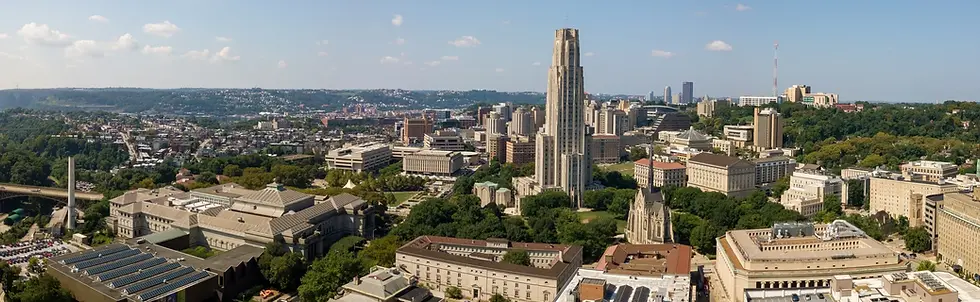
📸: Aerial shot of the University of Pittsburgh's Cathedral of Learning, the second tallest educational building in the world, with downtown Pittsburgh in the distance.
affiliations with professional organizations

Track Coordinator & Consultant
Assessment
Institute
Student Affairs & Cocurricular Programs
Indianapolis, IN
March 2021 to present

Member & Contributor
Student Affairs
Assessment Leaders
Host Institution: University of Buffalo
Buffalo, NY
July 2016 to present

Institutional Member
Association of College
Unions International
Local: Region VII
Bloomington, IN
July 2009 to July 2021

Member & Volunteer, Jan. 2004 to Apr. 2023
Nat'l. Assoc. for Campus Activities
Columbia, SC
Research & Scholarship Group
Chair, May 2019 to April 2021
Member, September 2015 to May 2021

Institutional Member
Student Affairs Administrators
in Higher Education
Local: Region II
Washington, DC
July 2009 to July 2021

Institutional Member
College Student Educators
International
PA College Personnel Association
Washington, DC
July 2009 to July 2021

Institutional Member
American Student Government
Association
Local: Illinois ASGA Conference
Gainesville, FL
July 2022 to April 2023

Cocurricular Director & Institutional Rep.
Skyway Conference of
Community Colleges in Illinois
Member: College of Lake County
Grayslake, IL
July 2022 to July 2023
skills, interests, values, & motivators

MY EXPERIENCES & EDUCATION HAVE GIVEN ME A TON OF SKILLS & AREAS OF INTEREST.
BUT WHAT MAKES ME TICK? WHAT DRIVES ME TO EXCEL? WHAT ARE MY TRUE PASSIONS?
EXPLORE :
What are some awesome pieces of evidence showcasing my skills & interests?
What are my Top 10 work strengths according to Gallup*Clifton StrengthsQuest?
How do I tend to interact with the outside world & process information according to my Myers-Briggs Typology Personality Type?
How do I tend to interact with my work & my projects according to my Enneagram Personality Type Assessment?
How do I tend to interact with others according to my DiSC Work Styles Type?
WALKING THROUGH TIME: A PHOTO GALLERY OF SKILLS & INTERESTS

ENGAGEMENT & INVOLVEMENT'S


IMPACT ON STUDENT SUCCESS
STRATEGIC THINKING
DOMAIN
STRENGTHSQUEST TOP-10® STRENGTH TYPES
INFLUENCING
DOMAIN
ACHIEVER
Achievers work hard & possess a great deal of stamina. They take immense satisfaction in being busy & productive, accomplishing tasks, & thinking critically.
INDIVIDUALIZATION
Individualizers see the unique qualities of each individual person, & they tend to shy away from generalizing people or categorizing them into broad themes or types. They are gifted in figuring out how different people can work together productively on a team.
LEARNER
Learners have a great desire to continuously gather knowledge & new skills, & they commit to continuous improvement of themselves. The process of learning (rather than just the outcome) rocks!
INPUT
Inputers collect & archive... & that could be physical things (knick-knacks or collectibles) or mental / emotional things (like knowledge or facts). They gather info, ideas, artifacts, & even people in various forms.
CONTEXT
Contexters enjoy thinking about & really understanding the past, for understanding the past is how they best understand the present & forecast the future. The past represents order.
STRATEGIC
Strategizers plan, plan, & plan. They create alternative work-arounds, just in case original plans fall apart. They problem-solve quickly & can quickly spot patterns & predict issues.
WOO
Woo'ers love meeting new people & making them become their friends, even if it becomes a bit of a challenge! They are satisfied by breaking the ice & making connections with people.
COMMUNICATION
Communicators are quite adept at translating thoughts into words, easily convince others to believe ideas & plans, & are good conversationalists & presenters.
CONNECTEDNESS
Connecters have a deeply-held faith that everything - every person, every act, every decision, is intertwined. There are few coincidences & that almost every event & every eventuality has meaning & happens for a reason.
ACTIVATOR
Activators make things happen, turning thoughts into action! They want to do things now rather than endlessly talking about them. They tend to excel at building & operating by checklists.
MYERS-BRIGGS TYPOLOGY INDICATOR® PERSONALITY TYPE: ENFJ


What does my MBTI personality of ENFJ mean?
Extraversion (E): I tend to focus on the outer world, drawing energy from interacting & processing information with others, as well as meeting new people & trying new, exciting things.
Intuition (N): I tend to collect information by relying on my gut, interpreting information & adding meaning through theories, possibilities, & big ideas, not just with facts & logic.
Feeling (F): I tend to make decisions by examining people & circumstances (as well as my own strong emotions, values-centered compass), not just assuming everything to be black-and-white.
Judging (J): I tend to prefer making firm decisions, using stark honesty, & running an organized schedule when interacting with the outside world, not just absorbing new information.
What traits do ENFJs have according to the original authors?
ENFJs are warm, empathetic, responsive, & responsible. They are highly attuned to the emotions, needs, & motivations of others. ENFJs find the potential in everyone, & want to help others fulfill their potential. They often act as catalysts for individual & group growth. They are also loyal, responsive to praise, & responsive (but a little too touchy) to criticism. ENFJs are HIGHLY sociable. They facilitate others in a group & they provide inspiring leadership (excerpted from www.myersbriggs.org/my-mbti-personality-type/mbti-basics/the-16-mbti-types.htm.).
ENFJs are referred to as 'Giver,' 'Protagonist,' 'Leader,' 'Teacher,' 'Mentor,' & 'Hero.' Why?
Strengths of ENFJs include: tolerant & open to new ideas, reliable, insightful, charismatic, altruistic, organized, fantastic communicators, & natural leaders.
Weaknesses of ENFJs include: overly idealistic, sensitive, & selfless, with fluctuating self-esteem, are prone to melancholy, & struggle to make tough decisions (especially when there's a no-win situation).
Ideal careers for ENFJs include: teaching, social work, religious service, counseling or advising services, & politics, especially local politics.
Famous ENFJs include: Barack Obama, Martin Luther King, Jr., Oprah Winfrey, Malala Yousafzai, Sean Connery, Alexandria Ocasio-Cortez, Meghan Markle, Matthew McConaughey, Tupac Shakur, Drake, Pope John Paul II, Jimmy Stewart, Morgan Freeman, Maya Angelou, Abraham Maslow, & yes... even Albus Dumbledore!


ENNEAGRAM PERSONALITY TYPE: THE CHALLENGER & THE BEAR


What is the Enneagram Personality Inventory?
The Enneagram (primarily) helps us to more deeply come to know ourselves, to be more objective & critical of ourselves, & to assist us in our paths to self-understanding, self-knowledge, self-determination, & self-actualization.
Some Other Important Points to Keep in Mind:
-
People's dominant personality types do not change.
-
Personality types & descriptions are universal, applying equally across identities, as the instrument was designed with equity-mindedness.
-
Not every part of the description in each personality type will fit every person in that dominant type; identity typology is all about descriptive not predictive analysis.
-
Humans change all the time among healthy, average, & destructive personality traits.
-
Numbers are value neutral & do not apply value or meaning; as such, no personality type is inherently better or worse than another. All personalities have unique assets & liabilities, desires & deficiencies, fears & motivators.
-
It's perfectly natural to feel unhappy with your personality type or its description; by learning about each type, we can learn to better leverage our assets & strengths, avoid our liabilities & fears, learn from other types, & become our best selves.

So What Can We Learn About Mine?
My Enneagram personality type is Type Eight: The Challenger. Challengers are usually known as being self-confident & decisive leaders, but at their worst they can come across as willful & confrontational. My personality type is also heavily influenced by my Type Nine Wing: The Bear, which results from my high alignment in Type One, Type Two, Type Three, & Type Four, despite my very low alignment with Type Nine. Challenger-Bears, despite their aggressive sounding name, are very warm, reliable, & helpful, advocating for others, detecting threats, & protecting loved ones.
Other Influences on My Personality Type:
-
INFORMATION PROCESSING: INSTINCTIVE - - Primarily, Types Eight, Nine, & One process information by relying on their gut instincts, learned experiences, & their own logic, versus emotional feelings or thoughtful contemplation of others.
-
EMOTIONAL RESPONSE TO SELF-DEFICIENCIES: ANGER - - Emotionally, Types Eight, Nine, & One respond viscerally to their own shortcomings & failures, either quietly or explosively directing anger inwardly, which plants seeds of self-doubt. This anger negatively impacts relationships with others as it tends to extend.
-
BEHAVIORAL INSTINCT WITH OTHERS: ATTRACTION - - Instinctually, this personality type is preoccupied with finding chemistry & closeness between themselves & others, being deeply stimulated & interested by those interactions. This can manifest physically, emotionally, mentally, or spiritually.
Type 8: The CHALLENGER -- Powerful & Dominating
Type 8s are named The Challenger because, of all the types, they enjoy taking on challenges, as well as giving others opportunities to challenge themselves. They are charismatic & have the physical & psychological capacities to persuade others to follow them. From starting a company, to rebuilding a city, from waging a war, to making peace, Type 8s have enormous willpower & vitality; they feel most alive when they are exercising these capacities. They use their abundant energy to affect changes in their environment, so as to leave their mark, but also to keep the environment & especially other people from hurting them & those they care about. At an early age, Type 8s understand that this requires strength, will, persistence, & endurance, which are qualities that they develop in themselves & value in others.
Type 8 In Brief: They are self-confident, willful, strong, assertive, protective, resourceful, straight-talking, & decisive, but can also be egocentric & domineering. They must control their environment & its people, sometimes becoming confrontational & intimidating, struggling with their tempers & with vulnerability.
At Their Best: They are self-mastering, heroic, magnanimous, & inspiring, serving as a source of strength to improve others’ lives.
Basic Fear: Being harmed, denigrated, or controlled by others. Basic Desire: Protecting themselves, controlling their own life, & directing their own destiny.
Key Motivations: Relying on themselves, proving their strength, resisting weakness, gaining importance or recognition, & controlling their environment.
Famous Type 8s: Franklin D. Roosevelt, Winston Churchill, Oskar Schindler, Martin Luther King, Jr., Lyndon Johnson, Mikhail Gorbachev, Indira Gandhi, John McCain, Pablo Picasso, Ernest Hemingway, Norman Mailer, Toni Morrison, Serena Williams, James Brown, Aretha Franklin, Queen Latifah, John Wayne, Frank Sinatra, Sean Connery, Paul Newman, Clint Eastwood, Tommy Lee Jones, Jack Nicholson, Matt Damon, & Barbara Walters
Type 3: The ACHIEVER -- Success-Oriented & Pragmatic
Type 3s are named The Achiever because, when healthy, they really can & do achieve greatness. They are the 'stars' of human nature & people look to them for their accomplishments & graciousness. Type 3s unconsciously value developing themselves & uplifting others; being well-regarded & popular, others idolize 3s as they see their hopes & dreams in themselves. Why are Type 3s so successful & well-liked? They believe in themselves & in developing their talents & capacities, acting as living 'role models' given their ability to embody socially valued qualities & norms, & ensuring their lives are a success. Yet, they note that the definition of success is fluid & contingent upon family, culture, society, etc. No matter which definition, however, 3s become somebody in their environment; they refuse to be a nobody.
Type 3 In Brief: They are self-assured, adaptable, & charming, which supports their excelling in various ventures. Ambitious, competent, energetic, diplomatic, & poised, they are status-conscious & strive to advance, but can also be image-focused & self-conscious. They tend to struggle with workaholism & competitiveness.
At Their Best: They are self-accepting & authentic, serving as role models who inspire others.
Basic Fear: Feeling & being worthless. Basic Desire: Feeling & being valuable & worthwhile.
Key Motivations: Being affirmed, distinguishing themselves & receiving attention from others, being admired by others, & impressing others.
Famous Type 3s: Bill Clinton, Tony Blair, Condoleezza Rice, Arnold Schwarzenegger, Muhammed Ali, Mitt Romney, Andy Warhol, Truman Capote, Oprah Winfrey, Tony Robbins, Michael Jordan, Lance Armstrong, Elvis Presley, Paul McCartney, Whitney Houston, Jon Bon Jovi, Lady Gaga, Taylor Swift, Justin Bieber, Barbra Streisand, Jamie Foxx, Richard Gere, Will Smith, Reese Witherspoon, & Anne Hathaway
Type 1: The REFORMER -- Rational & Idealistic
Type 1s are named The Reformer because, at their core, they are driven by a 'sense of mission' to improve the world, growing their influence & using such to conquer this bold mission. They overcome adversity to uplift the power & resilience of the human spirit: that anyone can make a difference & that 'higher values' do exist even at the cost of personal sacrifices. 1s value practical action, reducing pain & disorder present in their own community. They are activists, searching for an acceptable rationale for their instincts & passions; they use convictions & judgments to direct themselves & their actions. In an effort to not offend other types, 1s may resist their instinctual drives, resulting in repression, resistance, melancholy, & aggression. They are sometimes seen by others as highly self- controlled, even rigid.
Type 1 In Brief: They are conscientious, with strong senses of right & wrong, purpose & calling, & principles & ethics, being teachers & advocates for change, striving to improve the world. Well-organized & fastidious, they struggle with self-criticism, control, resentment, impatience, perfectionism & fear of mistakes.
At Their Best: They are self-aware, wise, discerning, realistic, & noble, serving as a morally heroic figure for others.
Basic Fear: Being corrupted, defective, evil, or harmful. Basic Desire: Being good, having integrity, & being balanced.
Key Motivations: Being justified, striving higher, improving, remaining consistent with ideals & beliefs, & avoiding criticism or condemnation by others.
Famous Type 1s: Joan of Arc, Sir Thomas More, Mahatma Gandhi, Pope John Paul II, Nelson Mandela, Jimmy Carter, Michelle Obama, Al Gore, Hillary Clinton, Sandra Day O’Connor, George Bernard Shaw, George Harrison, Celine Dion, Ralph Nader, Keith Olbermann, Jerry Seinfeld, Bill Maher, Tina Fey, Katherine Hepburn, Maggie Smith, Emma Thompson, Julie Andrews, Meryl Streep, Harrison Ford, & Captain “Sully” Sullenberger
DiSC® WORK STYLE TYPE: DOMINANCE


What is DiSC?
The DiSC Model helps transform daily work into best work experiences everyday by helping team members understand themselves & others better, improve relationships across teams, & leverage strengths & personality traits to one's benefit. It allows you to reflect deeply about team cohesion, communication, collaboration, conflict resolution, & environmental empowerment. There are four primary work style types, according to the DiSC Model:
Dominance (D): Direct, Firm, Strong-willed, Forceful, & Results-oriented
Influence (i): Outgoing, Enthusiastic, Optimistic, High-spirited, & Lively
Conscientiousness (C): Analytical, Reserved, Precise, Private, & Systematic
Steadiness (S): Even-tempered, Accommodating, Patient, Humble, & Tactful
How does the DiSC Model work?
Above, find the DiSC! Each DiSC is divided into 4 equal sections for the primary types (D, i, S, C), which are then subdivided further into three specific subtypes, which are influenced by the adjacent types to one's dominant type (Di, DC, iD, iS, Si, SC, CS, & CD). These divisions provide for us the 12 DiSC Work Style Types! When a team member completes the online assessment tool, an analysis of their responses will provide for them a DOT to indicate their identified type. This DOT tells us three important pieces of information: 1.) a team member's individual work style type, 2.) the DOT's distance from the edge indicates the strength of influence that type has upon the team member, as in the closer the DOT is to the edge of the DiSC, the stronger the type influences that team member, & 3.) the DOT's position within the type's region also represents the influence of other types upon that team member.
I am a DOMINANCE Style, close to the edge & centered in the region. What does that tell me? What traits do D-STYLES tend to share?
D-STYLES are strong-willed & prioritize getting results. Because they want to make their mark, they constantly look for new challenges & opportunities. They value competition & are action-oriented, so they tend to focus on working quickly & forcefully. They are often fact-paced & like it when others cut to the chase like they do. D's speak up when they see a problem or an inefficiency, as they are natural skeptics having questioning, independent minds. D's are often quick to write off people whom they see as incompetent & they often cannot hide their annoyance. When irritated, people know it, as D's tend to let their nonverbals speak louder than their words. Given their competitive streak, D's also tend to suspect others of being driven by self-interest & expect others to taken advantage of them; they're unlikely to take compliments at face-value since they assume alternate intentions behind words of others. D's strong beliefs, self-confidence, dismissal of lesser opinions, & assertive energy also gives others the impression that they are arrogant, uncaring, & unapproachable. They're also often perceived as being a bulldozer, insistent, competitive, impatient, demanding, insensitive, & asking too much.
My DOT's Position: close to edge, centered regionally = heavily influenced by typical D-Style traits; not particularly influenced by other styles.
Characteristics & Values: getting results; making progress; pushing through obstacles; taking action; challenging oneself & others; generating enthusiasm.
Shared Leverage Points with Other Types: active; fast-paced; outspoken; dynamic; bold; questioning; logic-focused; objective; skeptical; challenging.
Motivations: power & authority; competition; winning; success. Fears: loss of control; being taken advantage of; vulnerability; appearing weak.
What D's Enjoy: implementing ideas; leading the team; achieving results; overcoming obstacles; innovating change; making decisions; getting things moving; creating enthusiasm; uniting teams behind a goal; inspiring others to do their best.
What Stresses D's Out: following strict rules or protocols; getting bogged down in inefficient processes or meetings; having ideas challenged; having little autonomy or independence; lacking control; slowing down pace; dealing with people who don't meet standards; being unable to express oneself; working in dull environments.
GREGORC STYLE DELINEATOR® THINKING & LEARNING TYPE: SEQUENTIAL
What is the Gregorc Style Delineator of Thinking & Learning Types?
The Gregorc Style Delineator provides professionals a theoretical model that is helpful & useful for understanding differences in thinking & learning preferences so that other colleagues may mindfully collaborate & communicate more effectively. Regarding thinking, some individuals prefer sequential processes, starting at the beginning & ending at its end. Others prefer a more randomized approach, going from step 1 to step 7 to step 3 to another project completely. Regarding learning, some individuals depend on physical senses, logic, & observations; others prefer broad ideas, concepts, or theories.
Sequential Thinkers: Like clockwork, a process followed step-by-step, over a period of time
Random Thinkers: Like a stopwatch, starting & stopping at will, subject to what's important at the moment
Concrete Learners: Learns by interacting with the physical world, what they can see, touch, hear, taste, smell
Abstract Learners: Learns through ideas & feelings, using reason & intuition with ideas, concepts, & feelings

Therefore, Anthony Gregorc, Ph.D., conceptualized a two-dimension axis model that showcases how these individual thinking & learning styles interact & interplay to create 4 Distinct Work Style Types: CR (Concrete-Random), CS (Concrete-Sequential), AR (Abstract-Random), & AS (Abstract-Sequential). When a team member completes the online or paper assessment tool, an analysis of their responses will provide for them plot-points on each Work Style Type axis; the higher the value is (or the wider the plot point is away from the center point), the stronger that type is associated with that individual's work style. And yes! One can relate with multiple types.
Above, find my Style Delineator Graph. I am CONCRETE- & ABSTRACT-SEQUENTIAL. What does that tell me? What traits define my style?
I scored 32 points in both CS & AS styles. I align strongly as a SEQUENTIAL thinker; I also equally align as a CONCRETE learner & ABSTRACT learner. This means that I prefer process maps, to-do lists, & operation manuals, but I equally value physical senses, logic, & observations, as well as, broad ideas, concepts, & theories.
CONCRETE-SEQUENTIAL Quick Facts
-
practical & organized
-
planning work & working their plan
-
thinking = logical, instinctive, & deliberate
-
strive for perfection & have an eye for detail
-
focus on material reality & physical objects
-
creativity = making something more effective than the original
-
prefer ordered, practical, quiet, & stable spaces
ABSTRACT-SEQUENTIAL Quick Facts
-
develops ideas in a logical way
-
how someone feels about something does not change reality
-
thinking = intellectual, analytical, correlative, fluid, & quick
-
loves books, reading, research, & experiments
-
focus attention on knowledge, concepts, & ideas
-
creativity lies within models, theories, analysis, & synthesis
-
prefer ordered, quiet, independent, & mentally stimulating spaces
CONCRETE-SEQUENTIAL Traits
-
Likes: order; predictability; logical sequence; following directions
-
Learns best in: structured environment
-
Dislikes: incompletion; disorganization; unclear direction; unclear answers
-
What makes sense: step-by-step processes; following schedules
-
Intolerable: people too emotional or too academic; inaccuracies
ABSTRACT-SEQUENTIAL Traits
-
Likes: their points to be heard; analyzing before deciding; applying logic
-
Learns best in: environments where they can work alone
-
Dislikes: expressing emotions; too little time to be thorough
-
What makes sense: well-researched info; work through ideas thoroughly
-
Intolerable: lack of logic; hazy memory; sentimental thinking; excessive rules